Verifiable AI
for Pathogen
Genomics

Where Does AI Fit in Our Work?
AI is all around us — and we're all figuring out how it fits into scientific work.
- Enthusiasts, skeptics, and everyone in between — the room doesn't have to agree
- What's needed is a scientific approach to the question itself: evaluate model behavior, identify patterns and failure modes, systematically mitigate the risks

2026.10.26.761864
Not whether AI has a future in science — whether you can verify what it did.
Verifiable Agentic Science on Public Infrastructure — Baker, Cain, van den Beek, Chilton, Callan, Weaver, Coraor, Beavers, Goecks, Schatz, Grüning, Kosakovsky Pond & Nekrutenko. bioRxiv 2026.10.26.761864.
Thirty Agents, One Dataset
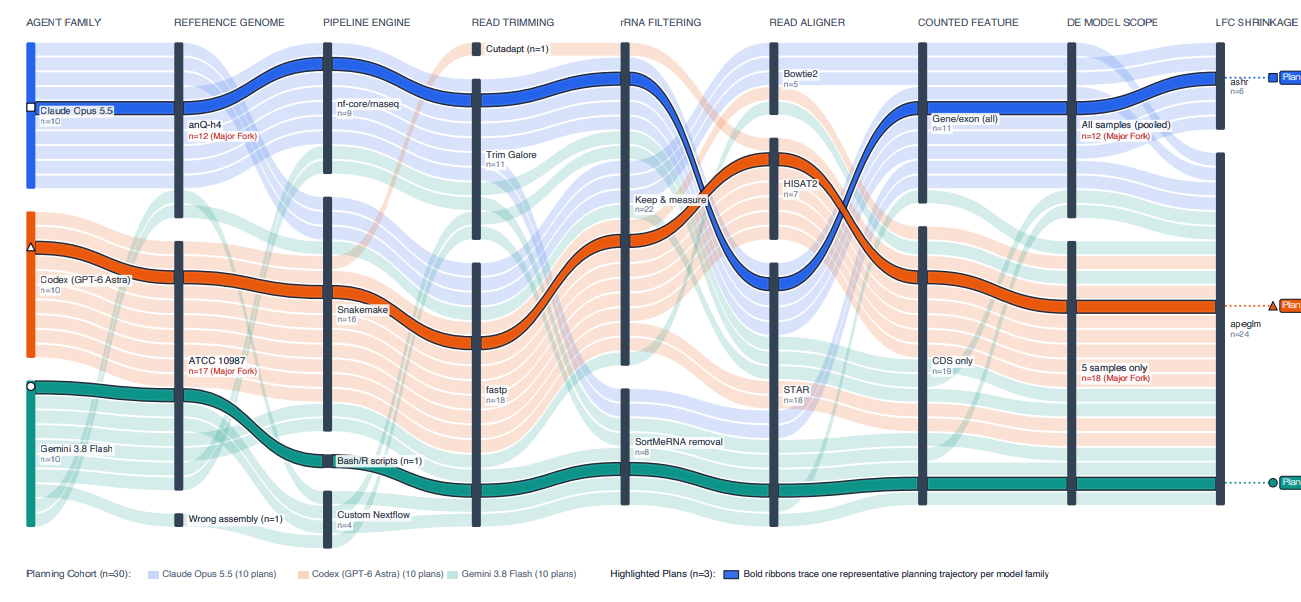
30 agents produced 18 incompatible pipelines — and they ran on local, unverified scripts.
Planning cohort, n=30 — bold ribbons trace one representative trajectory per model family. Figure: Verifiable Agentic Science on Public Infrastructure (bioRxiv 2026.10.26.761864).
What the Trail Actually Caught
Zoom in on those ribbons — every fork is a silent, consequential choice.
One plan's "B. cereus ATCC 10987" was actually Salmonella SC-B67 (GCF_000008105.1) — a mislabeled accession. And between valid assemblies: anQ-h4 lacks the cytK2 toxin locus entirely, so the toxin reads "undetected" vs. actively transcribed.
Engines ranged from custom Nextflow to ad-hoc Bash/R; aligners split HISAT2 / Bowtie2 / Kallisto; rRNA handling diverged on SortMeRNA. Four plans silently reversed library strandedness — real transcripts miscounted.
18 plans analyzed only the 5 target replicates; the rest — including all 10 Claude plans — pooled all 19 libraries to estimate variance. Same data, different statistical power, different DEG calls.
Two Failure Modes, Two Guardrails
The splintering isn't random — each failure mode maps to a mitigation.
Faced with ambiguous choices, agents diverge — same dataset, 18 incompatible pipelines.
Strong curation — curated organisms, assemblies, vetted workflows, and training materials, so the agent starts on checked ground.
Disposable local scripts — no record of versions, parameters, or steps. Nothing to check, nothing to rerun.
Execution on public infrastructure — every action provenance-tracked, every run shareable and auditable.
Three Doors, Same Infrastructure
Chat embedded in the site — zero install, zero account.
Public endpoints — bring your own client and model.
Agentic workbench that drafts and runs real workflows.
Whatever client you already use — including none — the work lands in the same verifiable place.
Analysis Assistant — the Zero-Commitment Door
- Chat on brc-analytics.org — no account, no install, no API key
- Answers catalog questions: "which assemblies for P. falciparum?", "which workflows accept this assembly?"
- It doesn't just talk — it hands off: suggests a workflow → opens the real launch form → pre-fills inputs
- Analysis runs in your Galaxy history: recorded, shareable, rerunnable
No terminal, no client, no setup — and still a real, auditable run.

/assistant
What a Session Looks Like
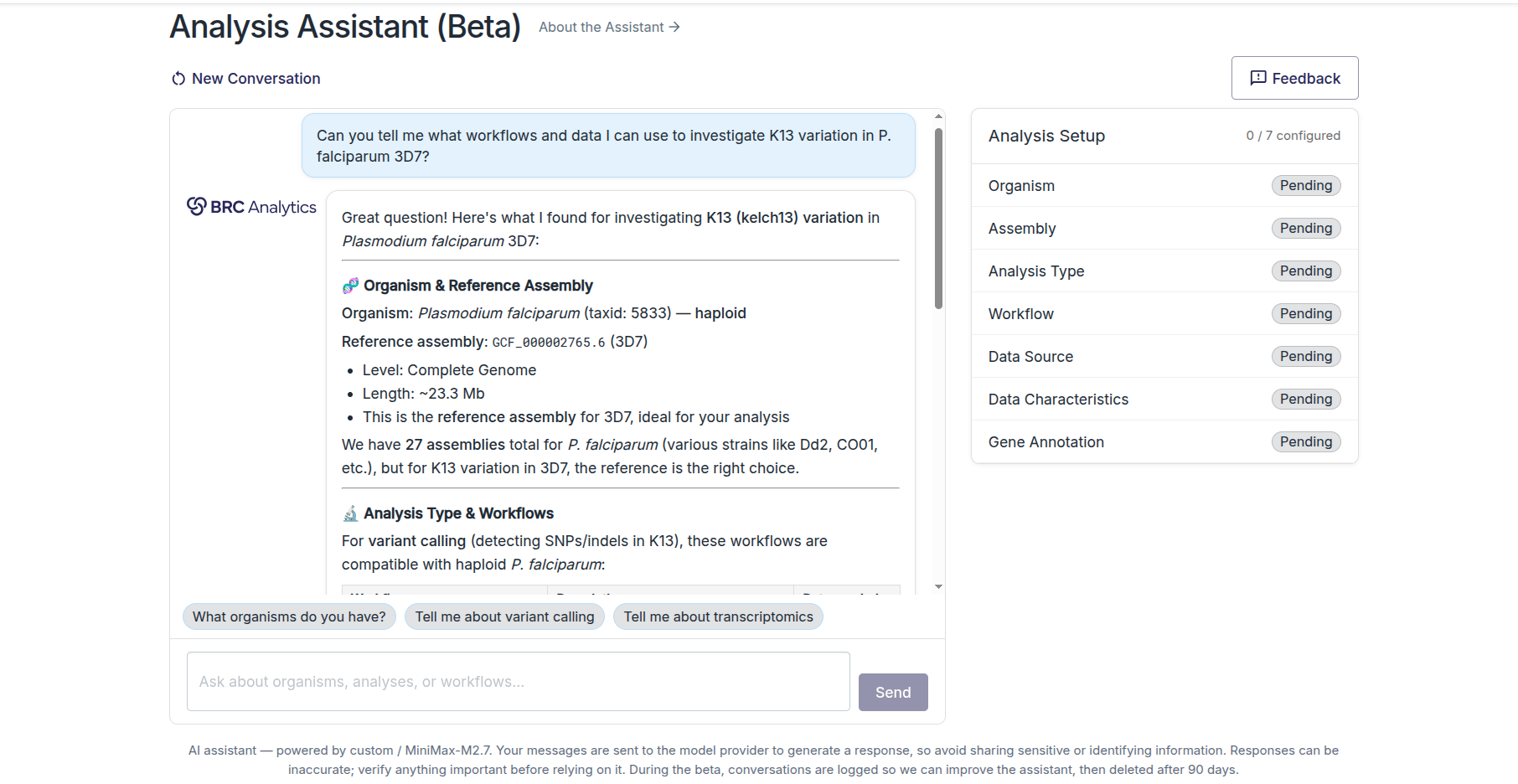
A real captured session — a plain question about K13 variation in P. falciparum 3D7 returns the organism, the right reference assembly out of 27, and compatible workflows — the setup checklist on the right tracks what's still to decide.
What a Session Looks Like
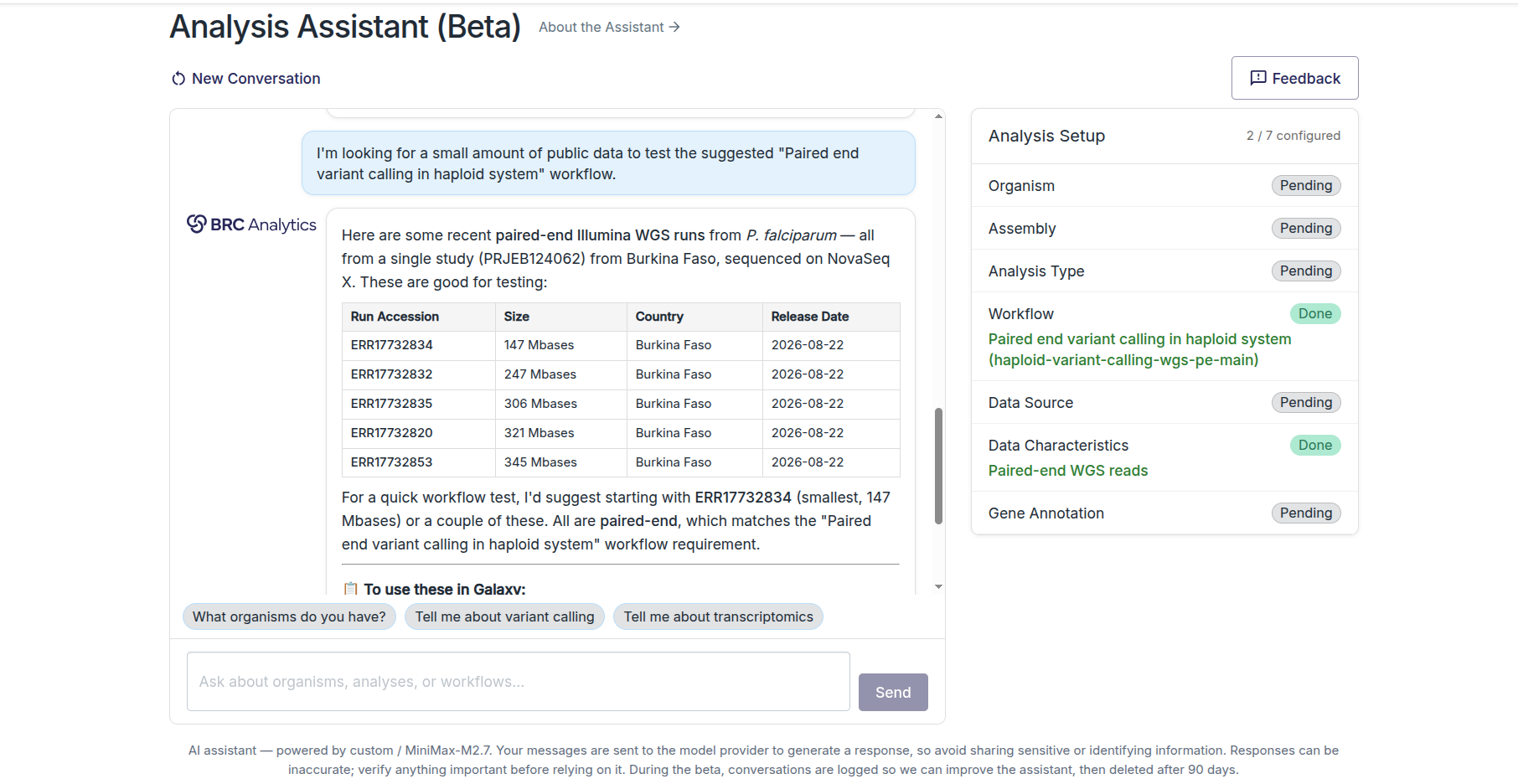
And refine — “a small test set for the suggested workflow?” returns concrete runs with sizes and a smallest-first pick — while the checklist moves: workflow and data characteristics, done.
MCP — Two Servers: What vs Where
- The guardrail: the agent sees curated answers — e.g. which workflows fit which assemblies — not raw tools it improvises around
- Works with Claude Code, Codex, Antigravity — any MCP client, your own scripts, a local model on university HPC. We don't pick your AI for you

/api/v1/mcp

uvx galaxy-mcp
Orbit — Agentic Workbench with a Paper Trail
- Install it locally — point it at any OpenAI- or Anthropic-compatible API
- Human gate at each step — the agent drafts plans and parameters; you approve and review before anything runs on Galaxy
- notebook.md + git = the record — a provenance trail, not a chat log
- Missing tool → agent authors a reviewable User-Defined Tool beta instead of silently improvising locally
- Export → gxformat2 → PR to iwc-lab — the workflow outlives the session
Orbit (galaxyproject/orbit) is the harness that turns ephemeral prompts into auditable scientific records.

galaxyproject/orbit
Where the Three Fit
For: everyone, right now, in a browser
Does: explore + launch
Records: Galaxy history + sessions in your BRC account
For: existing AI setups — Claude Code, Codex, Antigravity, local models
Does: guardrails + opinionated execution
Records: the history
For: verifiable agentic science — runs locally, keeps your LLM
Does: builds + runs end-to-end
Records: notebook + history + gxformat2
/assistant
/api/v1/mcp
uvx galaxy-mcp
github.com/galaxyproject
Different doors for different users — the same curation underneath, the same record on top.
Takeaways
- AI for science is fine — unverifiable AI isn't. Put the agent where the record lives.
- Three doors: assistant (web-only), MCP (your client, your model), Orbit (build + run).
- Curation is the guardrail; Galaxy is the record.
Assistant on brc-analytics.org · MCP endpoints public · Orbit on GitHub (galaxyproject/orbit).

10.64898/2026.10.26.761864